|


Welcome to Georgian Picture Gallery
Welcome to Georgia
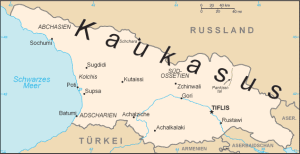
Georgia is a Eurasian country in the Caucasus located at the east coast of the Black Sea. It is bordered on the north by Russia, on the south by Turkey and Armenia, and on the east by Azerbaijan. It is a transcontinental country, located at the juncture of Eastern Europe and Western Asia.
Georgia is a representative democracy, organized as a secular, unitary, semi-presidential republic. Georgia was the second state to adopt Christianity as an official state religion after Armenia in the 4th century A.D.
Georgia is currently a member of the United Nations, the Council of Europe, the Commonwealth of Independent States, the World Trade Organization and the Organization of the Black Sea Economic Cooperation, and seeks integration with the European Union and NATO.

Following a crisis involving allegations of ballot fraud in the 2003 parliamentary elections, Eduard Shevardnadze resigned as president on November 23, 2003, in the bloodless Rose Revolution. The interim president was the speaker of the outgoing parliament (whose replacement was annulled), Nino Burjanadze. On January 4, 2004 Mikheil Saakashvili, leader of the United National Movement won the country's presidential election and was inaugurated on January 25. Fresh parliamentary elections were held on March 28 where NMD secured the vast majority of the seats (with ca. 75% of the votes) with only one other party reaching the 7% threshold (the Rightist Opposition with ca. 7.5%).
The vote is believed to have been one of the freest ever held in independent Georgia although an upsurge of tension between the central government and the Ajarian leader Aslan Abashidze affected the elections in this region.
Despite recognizing progress the OSCE noted the tendency to misuse state administration resources in favor of the ruling party.The tension between the Georgian government and that of Ajaria grew increasingly after the elections until late April. Climaxing on May 1 when Abashidze responded to military maneuvers held by Georgia near the region with having the three bridges connecting Ajaria and the rest of Georgia over the Choloki River blown up. On May 5, Abashidze was forced to flee Georgia as mass demonstrations in Batumi called for his resignation and Russia increased their pressure by deploying Security Council secretary Igor Ivanov.
On February 3, 2005, Prime Minister Zurab Zhvania allegedly died of carbon monoxide poisoning in an apparent gas leak at the home of Raul Usupov, deputy governor of Kvemo Kartli region. Later, Zhvania's close friend and a long-time ally, Finance Minister Zurab Nogaideli was appointed for the post by President Saakashvili.
Tbilisi is the capital and the largest city of Georgia, lying on the banks of the Mtkvari (Kura) River. Tbilisi is sometimes called Tiflis (or Tifflis), which is its Medieval non-native name. The city covers an area of 726 km² (280.3 square miles) and has 1,093,000 inhabitants.

Founded in the 5th century AD by Vakhtang Gorgasali, the Georgian King of Kartli (Iberia), and made into a capital in the 6th century, Tbilisi is a significant industrial, social, and cultural center.
The city is also emerging as an important transit route for global energy and trade projects. Located strategically at the crossroads between Europe and Asia and lying along the historic Silk Road routes, Tbilisi has often been the point of contention between various rivaling powers and empires.
The history of the city can be seen by its architecture, where the Haussmannized Rustaveli avenue and downtown
are blended with the narrower streets of the medieval Narikala district.
The demographics of the city is diverse and historically it has been home to peoples from different cultures, religions and ethnicities. Despite being overwhelmingly Orthodox Christian, Tbilisi is one of the few places in the world where a synagogue and a mosque are located next to each other, in the ancient Bath district several hundred meters from the Metekhi Church. In recent times, Tbilisi has become known for the peaceful Rose Revolution, which took place around Freedom Square and nearby locations after the contested parliamentary elections of 2003 led to the resignation of the Georgian President Eduard Shevardnadze.

Tbilisi has one international airport. Notable tourist destinations include Tbilisi Sameba Cathedral, Freedom Square, Sioni Cathedral, Metekhi, Narikala, Parliament of Georgia, Rustaveli Avenue, Turtle lake, Anchiskhati Basilica, Mtatsminda (Holy Mountain), Kashveti Church along with the National and Historic Museums of Georgia and numbers of art galleries. Tbilisi is the home of famous artists. The city life was immortalized in their art by Niko Pirosmani and Lado Gudiashvili.
Abanotubani ("bath district") is the ancient district of Tbilisi, Georgia, known for its sulfuric baths.
Located at the eastern bank of the Mtkvari River at the foot of Narikala fort across Metekhisubani, Abanotubani is an important historic part of the city the place, where according to a legend the King of Iberia,
Vakhtang Gorgasali’s falcon fell, leading to a discovery of the hot springs and, subsequentely, to founding of a new capital.
Kutaisi (Kutatisi, Kutaïssi) is Georgia's second largest city and the capital of the western region of Imereti. It is 221 km to the west of Tbilisi.
Kutaisi is located along both banks of the Rioni River. The city lies at an elevation of 125-300 meters (410-984 feet) above sea level. To the east and north-east, Kutaisi is bounded by the Northern Imereti Foothills, to the north by the Samgurali Range, and to the west and the south by the Colchis Plain.
Kutaisi was the capital of the ancient Kingdom of Colchis. Archeological evidence indicates that the city functioned as the capital of the kingdom of Colchis as early as the second millennium BC. It is widely believed by historians that when Apollonius Rhodius was writing about Jason and the Argonauts and their legendary journey to Colchis, Kutaisi/Aia was the final destination of the Argonauts and the residence of King Aeetes.
In 975-1122 Kutaisi was the capital of the united Kingdom of Georgia, and in the 15th century-1810 the capital of the Imeretian Kingdom. In 1810 the Imeretian Kingdom was occupied by Tsarist Russia. Before Georgia's independence in 1991, followed by the country's economic collapse, Kutaisi was a major industrial center. Today, many inhabitants of the city have to leave and work abroad in order to make a living. Small-scale trade prevails among the rest of population.
Batumi ( formerly Batum or Batoum) is a seaside city on the Black Sea coast and capital of Adjara, an autonomous republic in southwest Georgia. It has a population of 121,806 (2002 census).
Batumi, with its large port and commercial center, is also the last stop of the Transcaucasian railroad and the Baku oil pipeline. It is situated some 20 km (12 mi) from the Turkish border, in a subtropical zone, rich in citrus fruit and tea. Industries included shipbuilding, food processing, and light manufacturing.
Batumi lies at the northern periphery of the humid subtropical zone. Batumi's climate is heavily influenced by the onshore flow from the Black Sea and the city is subject to the orographic effect of the nearby hills and mountains, resulting in significant rainfall throughout most of the year, making Batumi the wettest city in both Georgia and the entire Caucasus Region.
Poti is a city in the Samegrelo province in the west of Republic of Georgia. It is situated on the east coast of the Black Sea and therefore serves as one of the three Georgian ports on that sea. Nearby the city, the major river of Western Georgia, Rioni, enters the Black Sea.
Poti was founded as a Greek colony in the 7th century BC and named Phasis. For the first time in Georgia, a railway was constructed between Poti and Shorapani in 1871. In 1991 a European water-skiing championship took place in Poti. The legend about the Golden Fleece (the Argonauts, Jason and Medea) is geographically set in the town of Poti and the river Rioni. In 1986 the famous traveller Tim Severin stopped here during his "Golden Fleece" round.
The population of Poti is 47,149 according to 2002 figures.
Poti is divided into four municipalities: Center, Nabada, Island and Maltakva. Maltakva is renowned for its tourism facilities, hosting important sports events. In the old buildings, where Soviet soldiers used to live, now live refugees from Abkhazia. Poti is located at an altitude of two meters above sea level. It has a subtropical climate. Winter is mild and warm. The average temperature in January equals 5.2 degrees Celsius, in July 22.9 degrees Celsius. Rainfall is abundant and reaches 1,960 mm per annum.
Three schools of higher education and more than 10 secondary schools function in town.
Service and food industry represent the most important sectors of the economy. The port (5 million tons per annum) is operational.
Poti is also a home to a main naval base and headquarters of the Georgian navy.
Gori is a city in eastern Georgia, which serves as the regional capital of Shida Kartli and the center of the homonymous administrative district. As of 2002, it had a population of 49,500.
Gori is located 76 km west of Georgia’s capital Tbilisi, at the confluence of the rivers Mtkvari and Greater Liakhvi, 588 m. above sea level. The climate is transitional from moderately warm steppe to moderately humid. Summer is usually hot. The average annual temperature is 10.9°C, minimal in January (-1.2°C) and maximal in August (22.5°C). The maximum precipitation falls in May (76mm) and minimum in August (34mm) and January (30mm).
Gori and its environs house several notable cultural and historical landmarks. Although for many foreigners Gori is principally known as Joseph Stalin’s birthplace, in Georgian historical memory the city has long been associated with its citadel, the Goris-Tsikhe, which is built on a cliffy hill overlooking the central part of Gori. On another hill, stands the 18th-century St. George’s church of Gorijvari, a popular place of pilgrimage. The ancient rock-hewn town of Uplistsikhe and the 7th-century Ateni Sioni Church are located not far from Gori.
Stalin’s association with the city is emphasized by the Joseph Stalin Museum in downtown Gori and the Stalin monument in front of the City Hall, one of the fewest of such monuments surviving Khrushchev’s de-Stalinization. The monument was a source of controversy in a newly independent Georgia in the 1990s, but the post-Communist government acceded to the Gori citizens’ request and left the statue untouched.
Borjomi is a resort town in south-central Georgia with a population estimated to be between 25,000 to 50,000. It is one of the districts of the Samtskhe-Javakheti region and is situated in the northwestern part of the region in the picturesque Borjomi Gorge on the eastern edge of the Borjomi-Kharagauli National Park.
The town is famous for its mineral water industry (which is presently the number one export of Georgia), the Romanov summer palace in Likani, and the WWF-site Borjomi-Kharagauli National Park. Borjomi mineral water is particularly well-known in those countries which were a part of the former USSR; the bottling of mineral water is a major source of income for the area. Because of the supposed curative powers of the area's mineral springs, it is a frequent destination for people with health problems. Borjomi is also home to the most extensive ecologically-themed amusement park in the Caucasus.
Kakheti is a province in Eastern Georgia. It is bordered by the small mountainous province of Tusheti and mountain-range of Greater Caucasus to the north, Azerbaijan to the east and the south, and the Georgian province of Kartli to the west.
Kakheti is geographically divided into the Inner Kakheti to the east of Tsiv-Gombori mountain-range and the Outer Kakheti to the west of it. The major river of the eastern part is Alazani, of the western part - Iori. Kakhetians speak a local dialect of Georgian.
Kakheti was an independent feudal principality from the end of the eighth century. It was incorporated into the united Georgian Kingdom at the beginning of the eleventh century, but for less than a decade. Only in the beginning of the twelfth century did Georgian King David the Builder (1089–1125)incorporate Kakheti to his Kingdom successfully. After the disintegration of the Georgian Kingdom, Kakheti became an independent Kingdom in the 1460s. In 1762, the Kakhetian Kingdom was united with the neighboring Georgian Kingdom of Kartli, with the capital of the former, Telavi, becoming the capital of the united Eastern-Georgian Kingdom of Kartl-Kakheti. Both Kingdoms were weakened by frequent Persian invasions. In 1801 the Kingdom of Kartl-Kakheti was annexed to the Tsarist Russian Empire.
In 1918–1921 Kakheti was part of independent Democratic Republic of Georgia, in 1922–1936 part of Transcaucasian SFSR and in 1936–1991 part of Georgian SSR. Since the Georgian independence in 1991, Kakheti is a region in the Republic of Georgia and Telavi is still its capital.
Svaneti or Svanetia is a historic province in Georgia, in the northwestern part of the country. It is inhabited by the Svans, an ethnic subgroup of the Georgians.
The landscape of Svanetia is dominated by mountains that are separated by deep gorges. Most of the region which lies below 1,800 meters (5,904ft.) above sea level is covered by mixed and coniferous forests. The forest zone is made up of tree species such as spruce, fir, beech, oak, and hornbeam. Other species that are less common but may still be found in some areas include chestnut, birch, maple, pine and box. The zone which extends from 1,800 meters to roughly about 3,000 meters (5,904–9,840ft.) above sea level consists of alpine meadows and grasslands. Eternal snows and glaciers take over in areas that are over 3,000 meters above sea level. The region is notable for its glaciers and picturesque summits. Svanetia's signature peak is probably Mt. Ushba which towers over the Inguri Gorge and can be seen from many parts of the region.
The Svans, the indigenous population of Svanetia, are ethnic subgroup of the Georgians. Until the 1930s, Mingrelians and Svans had their own census grouping, but were classified under the broader category of Georgian thereafter. They are Georgian Orthodox Christians, and were Christianized in the 4th-6th centuries. However, some remnants of old paganism have been maintained. Saint George, a patron saint of Georgia, is the most respected saint.
The Svans have retained many of their old traditions, including blood revenge. Their families are small, and the husband is the head of his family. The Svan really respect the older women in families.
Typically bilingual, they use both Georgian and their own, unwritten Svan language, which together with the Georgian, Mingrelian, and Laz languages constitute the South Caucasian or Kartvelian language family. The Svan language is being largely replaced by the Georgian proper. |